
Why Aircraft Speed Matters
Aircraft speed is much more than just a number. Faster aircraft can complete missions quickly, reduce travel time, escape dangerous situations, and improve military operations. Speed is also important for scientific research because engineers can test new technologies that may later improve commercial aviation.
The race for faster aircraft has led to many breakthroughs in aerodynamics, engine design, lightweight materials, and navigation systems. Every new generation of aircraft has helped engineers learn valuable lessons that continue to shape the future of aviation.
How Aircraft Speed Is Measured
Aircraft speed is usually measured in kilometers per hour (km/h), miles per hour (mph), or Mach numbers. A Mach number compares an aircraft's speed to the speed of sound.
For example:
- Mach 1 = Speed of Sound
- Mach 2 = Twice the Speed of Sound
- Mach 3 = Three Times the Speed of Sound
Many of the aircraft in this list travel well above Mach 2, while some experimental aircraft have reached Mach 6 or even faster. These incredible speeds require advanced engines, heat-resistant materials, and highly skilled pilots.
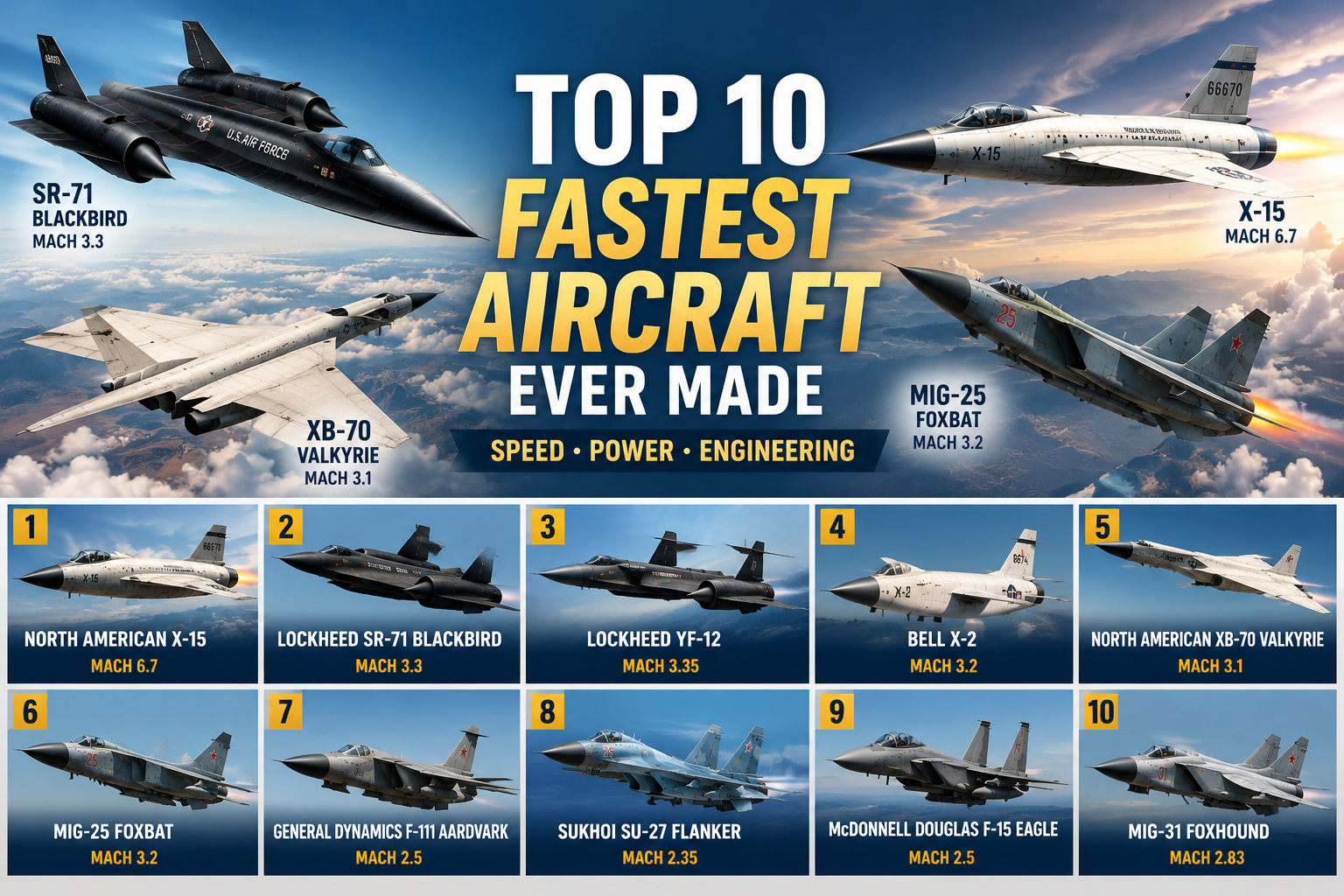
10. MiG-31 Foxhound
The MiG-31 Foxhound is one of the fastest interceptor aircraft ever built. Developed in Russia, it was designed to intercept enemy bombers, reconnaissance aircraft, and cruise missiles over very long distances.
The aircraft can reach approximately Mach 2.83, making it one of the fastest operational fighter aircraft in the world. Its powerful radar system allows it to detect targets hundreds of kilometers away, even in difficult weather conditions.
The MiG-31 remains an important aircraft because of its speed, long-range capabilities, and ability to carry advanced missiles for national defense.
H2: 9. McDonnell Douglas F-15 Eagle
The F-15 Eagle has been one of the world's most successful fighter aircraft for decades. Designed for air superiority missions, it combines high speed with excellent maneuverability and advanced combat systems.
With a top speed of around Mach 2.5, the aircraft has served in many air forces around the world. It is respected for its impressive combat record and strong reliability.
Modern versions continue to receive upgrades, including improved radar, electronic warfare systems, and more powerful engines, helping the aircraft remain effective even today.
8. Sukhoi Su-27 Flanker
The Sukhoi Su-27 is another famous high-speed fighter aircraft. It was created to compete with advanced Western fighter jets and quickly became known for its excellent performance.
The aircraft can reach approximately Mach 2.35 while maintaining outstanding agility during combat. Its aerodynamic design allows pilots to perform impressive air show demonstrations as well as real military operations.
The Su-27 has also become the foundation for several newer aircraft models used by different countries around the world.
7. General Dynamics F-111 Aardvark
The F-111 Aardvark introduced several advanced technologies that were considered revolutionary during its time. One of its most famous features was its variable-sweep wings, allowing the aircraft to adjust wing positions depending on flight conditions.
With a maximum speed of about Mach 2.5, the aircraft successfully completed bombing missions, reconnaissance flights, and electronic warfare operations.
Its combination of speed, range, and heavy payload made it one of the most versatile military aircraft of its generation.
6. MiG-25 Foxbat
The MiG-25 Foxbat shocked many aviation experts when it was first introduced. During the Cold War, very little was known about its true capabilities, creating concern among military planners worldwide.
The aircraft can fly at approximately Mach 3.2, making it one of the fastest military aircraft ever built.
Although designed primarily as an interceptor, it also served in reconnaissance missions where its incredible speed allowed it to avoid enemy aircraft and missile systems.
Aviation Technology Continues to Improve
Modern aviation continues to evolve every year. Engineers are now developing hypersonic aircraft capable of traveling much faster than current military jets. These future aircraft may use new engine technologies, advanced composite materials, artificial intelligence, and improved flight control systems.
Research organizations around the world continue testing designs that could reduce travel times dramatically while improving fuel efficiency and safety. The lessons learned from the fastest aircraft ever built continue to inspire the next generation of aerospace innovation.
5. XB-70 Valkyrie
The XB-70 Valkyrie was one of the most advanced bomber aircraft ever designed. It was built by North American Aviation during the Cold War to fly at extremely high speeds and altitudes. Although only a few prototypes were produced, the aircraft became famous for its futuristic design.
The XB-70 could fly at around Mach 3.1, making it one of the fastest bombers in aviation history. Its six powerful jet engines and unique wing design helped it maintain stability at very high speeds. While the program was eventually canceled, the technology developed for the XB-70 influenced future aircraft research and high-speed flight projects.
4. Bell X-2
The Bell X-2 was an experimental rocket-powered aircraft created to study high-speed flight beyond Mach 2. During the 1950s, engineers wanted to understand how aircraft behaved at extreme speeds where normal airplanes could no longer operate safely.
The Bell X-2 reached approximately Mach 3.2, setting important speed records at the time. The aircraft collected valuable data about aerodynamics, heat resistance, and aircraft control. Although the program faced many technical challenges, it helped scientists prepare for future supersonic and hypersonic aircraft development.
3. Lockheed YF-12
The Lockheed YF-12 was one of the fastest interceptor aircraft ever built. Developed from the same design family as the SR-71 Blackbird, it combined incredible speed with advanced radar and missile systems.
The aircraft could fly at around Mach 3.35, allowing it to intercept enemy aircraft before they reached protected areas. Even though it never entered full production, the YF-12 demonstrated how speed and technology could work together to improve national defense. Many of its innovations later influenced military aviation programs.
2. Lockheed SR-71 Blackbird
The SR-71 Blackbird is one of the most legendary aircraft ever created. Designed as a reconnaissance aircraft, it completed secret missions by flying faster than enemy missiles and fighter jets.
With a maximum speed of approximately Mach 3.3, the SR-71 remained one of the fastest air-breathing aircraft in history. Its titanium body was specially built to withstand the intense heat created during high-speed flight.
The SR-71 served for many years and collected valuable intelligence during important military operations. Even decades after its retirement, aviation experts continue to admire its engineering and unmatched performance.
1. North American X-15
The North American X-15 holds the title as one of the fastest aircraft ever made. Unlike traditional airplanes, it used a powerful rocket engine to reach extraordinary speeds and altitudes.
The X-15 achieved an incredible top speed of approximately Mach 6.7 (7,274 km/h). It also flew so high that some pilots qualified for astronaut wings because they entered the edge of space.
The information gathered during X-15 flights played a major role in the development of NASA's space missions and modern aerospace engineering. Even today, the X-15 remains one of the greatest achievements in aviation history.
Future of Hypersonic Aircraft
The future of aviation is moving toward hypersonic flight, where aircraft travel faster than Mach 5. Governments, aerospace companies, and research organizations are investing billions of dollars to develop next-generation aircraft capable of crossing continents in just a few hours.
Future hypersonic aircraft may use scramjet engines, advanced heat-resistant materials, artificial intelligence, and lightweight composite structures. These technologies could transform military aviation, scientific research, and even commercial air travel in the coming decades.
Interesting Facts About High-Speed Aircraft
Many people are surprised to learn that the fastest aircraft are not passenger airplanes. Most record-breaking aircraft were built for military or research purposes.
Some interesting facts include:
- The X-15 flew close to space.
- The SR-71 Blackbird expanded in size because of extreme heat during flight.
- Mach numbers change depending on altitude and air temperature.
- Modern fighter jets balance speed with maneuverability rather than focusing only on maximum velocity.
- Experimental aircraft continue to test technologies that may eventually benefit commercial aviation.
These achievements show how engineering continues to push the limits of what is possible.
Conclusion
The Top 10 Fastest Aircraft Ever Made demonstrate the incredible progress of aviation technology over the last several decades. From the legendary SR-71 Blackbird to the record-breaking North American X-15, each aircraft introduced new ideas that shaped modern aerospace engineering.
Although many of these aircraft are no longer in active service, their influence remains strong. Their technologies continue to inspire today's fighter jets, research aircraft, and future hypersonic transportation systems.
If you enjoy learning about technology, aviation, and innovation, keep exploring more informative articles. And if you love saving money while shopping online, visit https://freelivecoupons.com to discover the latest coupon codes, verified discounts, and exclusive online deals from popular stores.
Frequently Asked Questions (FAQs)
1. Which is the fastest aircraft ever made?
The North American X-15 is widely recognized as the fastest aircraft ever built, reaching approximately Mach 6.7.
2. What is the fastest military aircraft?
The Lockheed SR-71 Blackbird is one of the fastest military aircraft ever operated.
3. What does Mach mean?
Mach is a unit that compares an aircraft's speed to the speed of sound.
4. Why are hypersonic aircraft important?
They can reduce travel time, improve defense capabilities, and advance aerospace technology.
5. Is the SR-71 still in service?
No. The SR-71 Blackbird has been retired but remains one of the most respected aircraft in aviation history.
6. Can commercial airplanes reach Mach 3?
No. Most commercial passenger aircraft fly below the speed of sound for safety and fuel efficiency.
7. Will future aircraft be faster than the X-15?
Scientists continue researching hypersonic technologies, so future experimental aircraft may achieve even higher speeds.